Grenadine Reef Dower House Refuge
Just DesertsThe Grenadine Reef Dower House Refuge is the hidden humanitarian institution attached to the Grenadine Reef estate. It gives women endangered or socially ruined by male violence a protected interval in which to recover, alter their circumstances, and prepare to rebuild their lives. Its decisive importance lies in the contrast it establishes between conventional gentility and active moral responsibility: Lady Radha Pentland and Sir David Pentland do not merely express sympathy for abused women, but devote property, money, staff, provisions, and transport to helping them.
Purpose and Founding
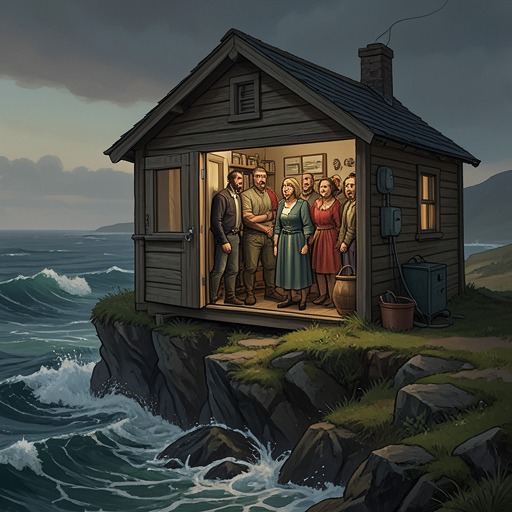
The refuge occupies the dower house at Grenadine Reef, a separate building concealed from the main house and neighboring farms by trees and bushes planted roughly thirty years earlier. Lady Radha and Sir David converted it into a refuge for women assaulted by men. The residents include young women who have lost their virtue, become pregnant, or suffered physical beatings. Many are servant women or tradesmen’s daughters, whose lack of family power and social protection makes the consequences of violence especially severe.
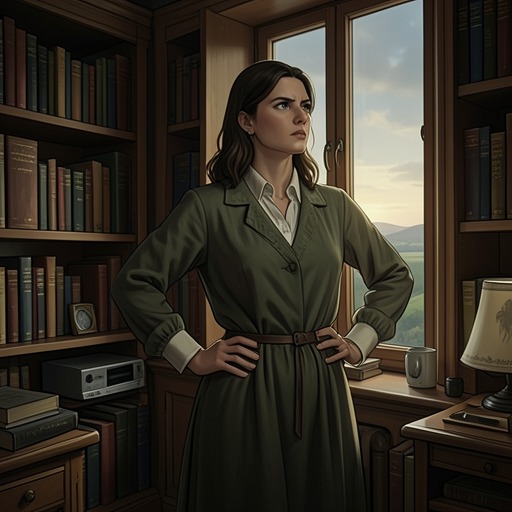
The institution grows directly out of Lady Radha’s own history. Born Radha Bhimani in Kutch in western India, she was raised among paternal relatives during repeated upheavals involving the Mughals, the Marathas, and the British. When she was only a year older than Elizabeth Bennet was during their conversation, she was kidnapped for sale into slavery. A Spanish ship rescued her off the coast of the Arabian Peninsula, but her safety led to forced confinement in a nunnery outside Cadiz. Later, while traveling from Cadiz toward Cartagena with twenty-nine other members of her order, she was captured by pirates.
Lady Radha was dragged onto the pirate deck and stabbed through the womb by the pirate captain. She survived a wound considered nearly fatal, remained behind because she was too ill to travel, and was cared for by Sir David at his house in Bridgetown on Barbados. After recovering from repeated infections, she faced gossip and hostility rather than uncomplicated gratitude. Sir David, a naval hero who had been knighted for his service, resigned his commission partly because of the treatment she received, returned with her to Britain, and married her. The refuge therefore embodies a response to a chain of forced movement, enslavement, captivity, sexual violence, medical danger, and social condemnation that Lady Radha had personally endured.
Structure, Care, and Daily Operation
The refuge is deliberately secluded and is not treated as a display of public charity. Sir David provides the funds but rarely discusses the dower house, leaving its operation to his housekeeper and staff. Food and other provisions are grown or purchased, and transportation is arranged and paid for. The house is self-contained, allowing residents to live away from the gaze of the surrounding society while they recover.
The refuge’s purpose is restorative rather than merely custodial. Women remain in safety before returning to reconstruct their lives, and their later choices differ according to their circumstances. Some emigrate to Canada to put as much distance as possible between themselves and their pasts; some change their names; no two stories are identical. The institution consequently recognizes that recovery cannot be reduced to one prescribed outcome. Its practical work includes shelter, food, protection, time, and the means to leave when remaining in the local community would preserve the danger or stigma.
The staffing arrangement also reflects the refuge’s relationship to trauma. Violet Harkness, the younger of the Harkness sisters, needed the refuge herself, while Vivian Harkness came to support her and help her recover. Both sisters became part of the small permanent staff. After Lady Radha’s death, they served as Elizabeth Bennet’s drivers and chaperones on the estate. Their presence links refuge work to survivor support: the women associated with the institution are not abstract objects of pity but participants in the continuing organization of protection and recovery.
Connection to the Pentland Estate
The refuge is one expression of the broader way Lady Radha and Sir David manage Grenadine Reef. Lady Radha does not spend hundreds on clothing or pursue an unattainable social standard; instead, the couple live modestly but very comfortably, maintain a well-run estate, and try to help people in need. Their charitable work is therefore financed through ordinary estate administration rather than separated from it as a decorative moral gesture.
Elizabeth Bennet learns from Lady Radha that the welfare of tenants is the responsibility of the master of an estate. Visits to tenants at Grenadine Reef improve the visits Elizabeth and Jane Bennet undertake at Longbourn, making their assistance more efficient and better suited to the tenants’ needs. In this setting, the refuge extends the estate’s duties beyond agricultural management. The household’s resources support not only land, provisions, and transport but also the physical and social reproduction of women whose families, communities, or institutions have failed to protect them.
The refuge also changes Elizabeth’s understanding of what it means to be a gentle-born lady. Through Lady Radha’s example, and alongside the example of Madeline Gardiner’s household management and charitable hospitality, Elizabeth comes to value practical care over conspicuous conformity. The refuge teaches through its existence that a woman’s influence may be exercised through property, organization, hospitality, financial decisions, and sustained emotional labor. It makes invisible work legible as a form of power.
Elizabeth Bennet’s Knowledge and Response
Elizabeth does not initially know the full nature of the refuge. Lady Radha alludes to the darkest parts of her past when Elizabeth is young, refusing to destroy a child’s innocence by stating everything openly. After Lady Radha’s death, Elizabeth explains the institution to Edward Gardiner and Madeline Gardiner, making clear that her earlier understanding had been incomplete. She has never visited the dower house, because it is secluded and hidden, and Sir David has never visited it either; his role is to provide the material support while the housekeeper and staff run it.
The Harkness sisters’ presence gives Elizabeth a personal connection to the refuge even before she understands its purpose. Vivian Harkness and Violet Harkness tell her the truth when she asks for a complete explanation, without questioning whether she should ask or whether she is ready to hear the answer. Elizabeth describes those conversations as deeply unpleasant, but they remain central to the way she understands Lady Radha’s life. The refuge transforms a concealed history of violence into an ongoing ethical obligation rather than allowing the estate to bury it behind ornamental privacy.
Lady Radha’s death makes the refuge’s continuity more urgent. She dies suddenly in her sleep from apoplexy, leaving Sir David devastated and Elizabeth grieving at her grave. Yet the institution survives because it was built into the estate’s practical arrangements rather than dependent only on Lady Radha’s personal presence. Its continuing existence becomes part of the inheritance that Elizabeth must understand when responsibility for Grenadine Reef passes to her.
Continuity After Sir David Pentland’s Death
After Sir David’s death, Elizabeth insists that the dower house should continue as a refuge. She plans to speak with Mrs. Perkins, Vivian Harkness, Violet Harkness, and the woman then responsible for its day-to-day organization. Elizabeth acknowledges that she has never entered the house, while also recognizing its essential character: it remains self-contained, invisible from the main residence and nearby farms, and a refuge in the fullest practical sense.
Fitzwilliam Darcy accepts Elizabeth’s decision without objection. The moment is significant because the refuge becomes part of the future estate’s settled purpose, not an expendable charitable expense that a new proprietor might remove. Elizabeth’s authority is expressed through continuity: she preserves the funding, supplies, and transport arrangements and keeps the institution under the care of the women who understand its work.
Narrative and Thematic Significance
The Grenadine Reef Dower House Refuge gives institutional form to the novel’s concern with women’s lack of agency, social double standards, and the recovery of abused women. Society condemns women for violence committed against them, while the refuge reverses that moral logic by treating safety and recovery as obligations. Lady Radha’s survival is not presented as a private triumph followed by silence; it becomes the foundation for protecting others who face related forms of coercion.
Its hidden location carries a double meaning. Concealment protects residents from gossip, retaliation, and public exposure, yet it also reveals how necessary safety remains when respectable society cannot openly acknowledge sexual violence. The refuge works against that silence through material action. It does not claim that every wound can be erased or that every life can return to its former shape. Instead, it offers women enough security, care, and choice to make a different future possible.
By preserving the refuge after both Lady Radha and Sir David are gone, Elizabeth turns inherited knowledge into deliberate policy. The dower house thus becomes more than a building attached to an estate: it is the enduring proof that wealth and property can be organized around female safety, that care can be collective rather than private, and that a woman’s response to violence can help establish a durable alternative to abandonment and shame.